
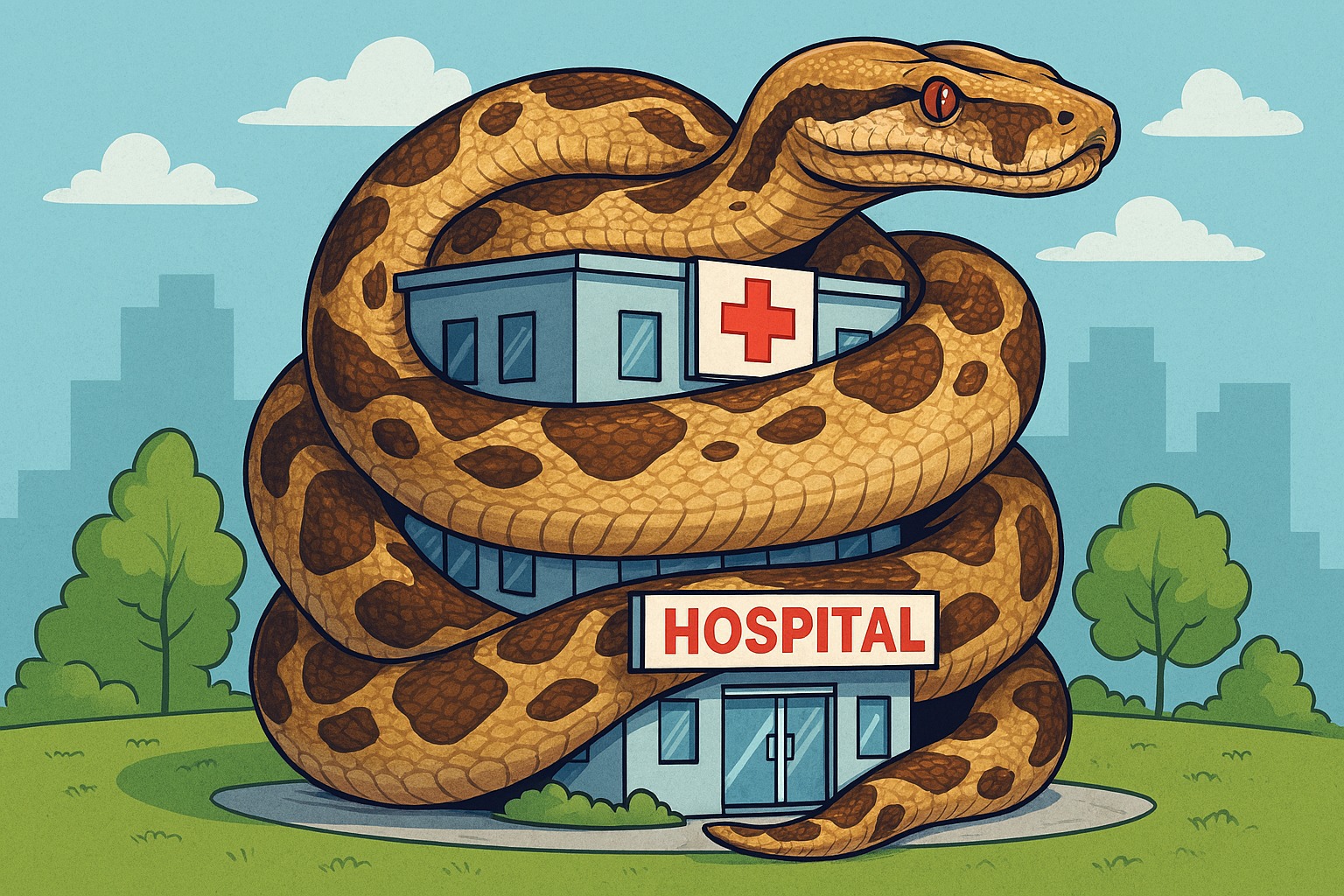
Why Uncontrolled Word Referrals Risk Squeezing the Life Out of Consultant Capacity
Across the NHS, Single Point of Access (SPoA) services are positioned as a way to simplify clinical pathways, improve triage, and create a more coordinated approach to managing referrals. In principle, SPoA has enormous potential. But without structure, without decision support, and without a way to translate subjective free-text into something clinically actionable, a modern SPoA can quickly become something very different:
A boa constrictor tightening around already overstretched consultant time.
The Problem: Unstructured In, Bottleneck Out
Every day, clinical teams receive Word documents, PDFs, fragmented symptom descriptions, and legacy templates—often hundreds of variations of essentially the same referral type.
What begins as a “single point of access” rapidly becomes a single point of pressure.
Here’s why:
1. Free-text referrals create triage friction
Without structure, every referral demands more time to interpret. Clinicians must search for the critical details—sometimes hidden in narrative paragraphs—before any decision can be made.
2. High variation makes automation impossible
If 50 practices use 50 versions of a document, your digital backlog grows exponentially. A SPoA becomes a human sorting office.
3. The burden shifts upstream… to consultants
When GP submissions lack required detail or clinical context, triage becomes guesswork. Cases are escalated unnecessarily. Routine patients get pushed into consultant queues simply because the information isn’t there to gatekeep appropriately.
The result?
Consultant capacity is squeezed.
Triage becomes slower.
Waiting lists grow.
And the SPoA, originally meant to relieve pressure, becomes the point applying the squeeze.
The Real Risk: Summer 2025 and Mandatory Advice & Guidance
As the national mandate expands A&G usage and pushes more clinically dependent decision-making into pre-referral stages, we’re approaching a tipping point:
- More clinical queries being raised before referral
- More attachments added to justify requests
- More complexity arriving at SPoA hubs
- More variation in how practices submit
· And no scalable way to manage the incoming volume using Word templates or email-based processes
Left unmanaged, this flow of uncontrolled content will only tighten—slowly, consistently—around secondary care time.
But It Doesn’t Have to Be That Way
A modern SPoA must move beyond “accepting documents.” It needs to guide, structure, and streamline.
1. Structure at the point of creation
Help GPs provide exactly what clinicians need. Not two pages too little. Not ten pages too much.
2. Clear clinical rules that auto-route referrals
Reduce avoidable consultant touch-time by automatically sending routine cases to the right place the first time.
3. Contextual integration with the clinical record
So that triage teams see the relevant details instantly, without searching through attachments.
4. A consistent, regional approach
One referral pathway. One structure. One clear picture of demand. Not dozens of fragmented templates evolving independently.
When SPoA is rebuilt on structured, clinically-aware digital workflows, it stops constricting capacity—and starts protecting it.
The Opportunity:
Turn SPoA From a Bottleneck Into a Clinical Decision Engine
If regions get this right, the SPoA becomes a force multiplier:
- Consultants receive better-prepared referrals
- Routine pathways become automated
- True clinical risk rises to the surface quickly
- Waiting lists stabilise
- Referrers get clarity and support
- Triage teams spend time where it matters most
SPoA stops being a choke point and becomes the central nervous system of elective care management.
Closing Thought
A SPoA cannot succeed if its inputs remain uncontrolled. Word documents don’t scale. Email inboxes don’t triage. Variation doesn’t automate.
But with the right digital foundation—built around structure, clinical rules, and integration—a SPoA can breathe again. More importantly, so can the consultants who rely on it.